ACSME 2024 Part 2 - Editorial
DOI:
https://doi.org/10.30722/33.02.000Abstract
This is the second issue of articles from the ACSME2024 conference held in Canberra with an overarching theme of “Belonging: The centre of the student experience”. The previous issue (Vol 33 Issue 2) contained a set of articles focusing on student belonging and mindset. The articles in this issue focus on support and success in teaching and learning, recognising the crucial role that educators have in student experience and identifying practical, scalable ways to support educators to better support their students. The articles also recognise that teaching-focused academics themselves benefit from a sense of belonging, particularly in institutions where research is given greater recognition.
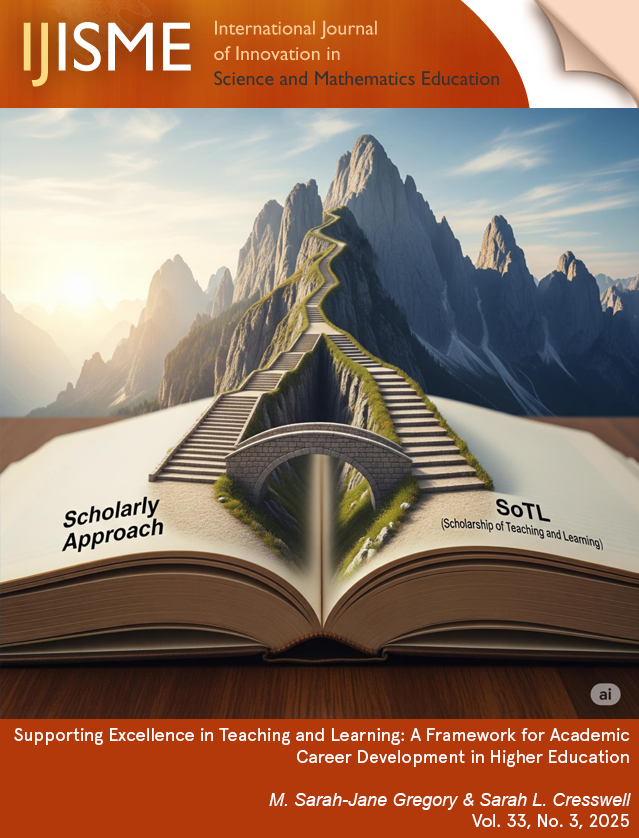
Our cover article by Sarah-Jane Gregory and Sarah Cresswell presents a framework designed to help teaching-focused academics to evidence excellence in their approaches to teaching and student learning to support promotion applications, performance reviews and career planning. They provide a useful tool to help highlight scholarly approaches to teaching and learning using language and guidance to suit any higher education institution.
Maia Bradley, Danielle Burgess and Judit Kibedi present the results of a training intervention on tutors’ self-efficacy beliefs toward teaching diverse learners. The paper presents useful insight via tutor and student perspectives of what it means to be a diverse learner. Their results show that providing tutors with training that enhances their ability to manage classrooms, and their confidence in engaging diverse learners using inclusive strategies, improves teaching for the tutors. In turn, it also creates an enhanced student experience.
Fu Ken Ly, Katherine Olston, Josh Aarts, Joshua Smith and Dashiell Moore’s article describes a diagnostic tool linked to personalised support which allows students to assess their mathematical knowledge. The Mathematics Academic Planner offers a scalable, institutional-wide resource with the potential for adaptation to different disciplines. The authors note that these tools need to be strongly integrated into the student experience with the use of good engagement strategies and embedding within an institutional support framework, such as orientation or advisory sessions, should be explored.
Teaching students how to clearly communicate their ideas in written form often consumes considerable time in the undergraduate curriculum notes Jennifer Fox. She presents a method of embedding reflection and annotation into many standard forms of writing tasks, such as prac reports and literature reviews, to help students evidence their process of learning while providing a richer learning experience.
We thank all the authors and reviewers who contributed to these two special issues, and hope that these articles continue to inspire and provide new insight into identifying and facilitating support and success in STEM teaching and learning.